Creative Burns
Why Scotland's political parties need to convince voters they are making their lives better

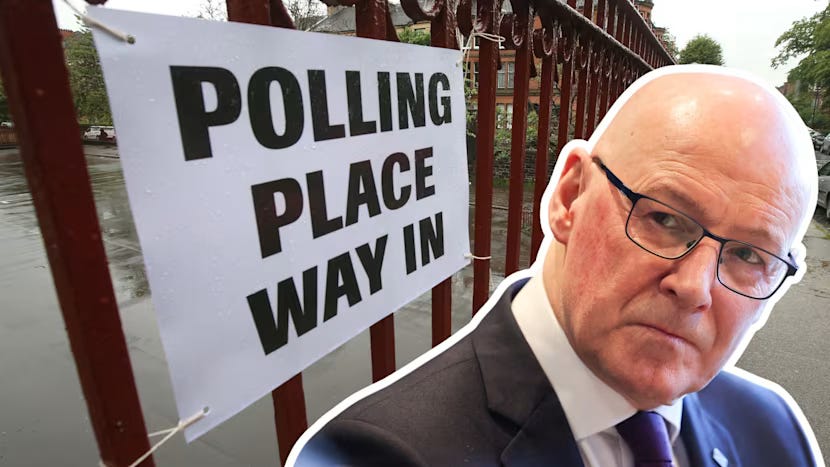
“There is no such uncertainty as a sure thing.”
The quote, attributed to Robert Burns, seems to sum up Scottish politics as we approach the bard’s birthday.
The SNP has a clear lead in the polls despite support for the party being much lower than it was five years ago.
Conventional wisdom in the political bubble is that a nationalist government will once again be returned next May.
Support for Scottish Labour has gone off a cliff as people let their views be known about the performance of Sir Keir Starmer as prime minister and the UK government as a whole.
Gratitude is free flowing within the SNP towards first minister John Swinney, who has steadied things over the last 20 months after a period where it felt like the party might be going off the rails.
As one cabinet minister recently told me…
It feels like Labour were relying on us carrying on being a shitshow but that hasn’t happened.
Quite the opposite, in fact.
Now despite that undoubted turn in fortunes, there has only been a slight increase in support for the SNP since its disastrous 2024 general election performance.
The party is still more than 10 points down from its result in the 2021 Holyrood election.
It may seem counterintuitive when looking at the current evidence but opposition parties still retain confidence of better than expected results next May.
Labour has all but written off constituencies in Dumfries and Galloway and the Borders but multiple sources who are campaigning in the central belt claim the reception on the doorsteps is much better than in the polls.
One senior Labour figure hit full optimism mode saying they believe they are in the “foothills of a campaign that looks a lot like 2011”.
That was a horrendous event for Labour with the SNP coming from 14 points behind in the early part of the year to win an unprecedented and as yet unrepeated majority at Holyrood.
So why does the party in red think it can pull off a reverse result?
“No one likes them,” the source said of the SNP. “Their vote is so soft.”
Now it is worth stating that no one believes the mood music around this election is like 2011, where voters largely rallied around an Alex Salmond-led SNP government which was broadly seen to have performed competently in its four years in power.
And Labour does not believe it is headed for a majority.
But it does think that John Swinney’s record in elections over his two stints as SNP leader – competed in four, lost four – gives it hope, as does a digital campaign that is popping up on 200,000 people’s devices every day.
They claim that a head-to-head between Swinney and Anas Sarwar framed around who they want running the country will fall in their favour.
This, though, largely relies on the campaign being focused on the SNP’s record in charge at Holyrood, not Labour’s since it took power at Westminster.
One Labour strategist admitted…
The suppressor of support for us just now is that people thinking voting for us think about Keir Starmer.
Will they think about that on polling day when it’s actually about their health service?
Maybe. But to do that the SNP has to make the argument that this election is not about them. Our argument is hard. Theirs is impossible.
There is compelling evidence that the SNP is keen to make the election a referendum on Starmer as well as about their plans for government.
For example, a press release this week on behalf of Westminster leader Stephen Flynn headlined that “the best way to get rid of Keir Starmer is to vote SNP on 7th May”.
But the cabinet minister mentioned earlier insisted all of the nationalists’ internal research shows it has “nothing to fear” when people’s minds focus on Holyrood.
That applies especially when voters are looking at who should head the next Scottish government, they said.
A recent public poll by Survation on behalf of True North Advisors put Swinney 17 points ahead of Sarwar when people were asked who would make the best first minister.
A second source close to Swinney said that reflects internal research and claimed the incumbent is “miles ahead” and “massively popular” with the swing voters that both Labour and the SNP believe will decide the election.
Still looming large over both parties – and the Scottish Conservatives – are Reform UK, who came second in a council byelection in Fife, which Nigel Farage’s party sees as strengthening its narrative that it is now the main challenger to the SNP.
Reform is troubling the Tories in every constituency across the Borders and Dumfries and Galloway but Russell Findlay’s party hopes that its rival’s powers have peaked with polling suggesting a current plateau in support both north and south of the border.
People around Findlay know May is going to be an election where the party loses MSPs but they are cautiously optimistic of defying expectations in a similar manner to previous contests.
There is hope that any sense of momentum draining away from Reform could drag voters back to the deeper shade of blue.
The amount of times strategists mention being a “mainstream” party of the centre-right is a clear – and striking, given UK leader Kemi Badenoch’s reported recent rejection of a shift to the centre – indication of the ground it wants to fight the election on.
Meanwhile, the Scottish Greens are aiming for 15 MSPs, including potentially the constituencies of Glasgow Southside and Edinburgh Central, and want at least one parliamentarian elected on the South Scotland regional list.
The Liberal Democrats are also confident of returning representation in our region but are most excited about becoming “Kings of the North” by sweeping up Highland constituencies as part of 10 seats being targeted by the party.
What should worry every party is research released earlier this week by the Joseph Rowntree Foundation, which found that 38 per cent of people feel politically dissatisfied.
A briefing by the anti-poverty charity said 73 per cent of people agreed that politicians care more about their party than the people they represent while 43 per cent did not see political decisions as having a positive impact on their community.
Deputy first minister Kate Forbes was in Galashiels on Friday visiting entrepreneurs and highlighting investment in the south of Scotland that she says will improve people’s lives.
She knows that argument needs to land with voters.
That Joseph Rowntree Foundation report also found that 58 per cent of people believe the Scottish government is responsible for improving the living standards of people in Scotland.
At the moment, all parties risk looking like “wee, sleekit, cowrin’, tim’rous beasties” in the eyes of the electorate, to quote one of Burns’ most famous lines.
If any of them can turn that perception around then they will roar, not squeak, on May 8 when the ballots are counted.